



Paving Inclusive Paths: Women Leading Open Mapping Across Asia-Pacific
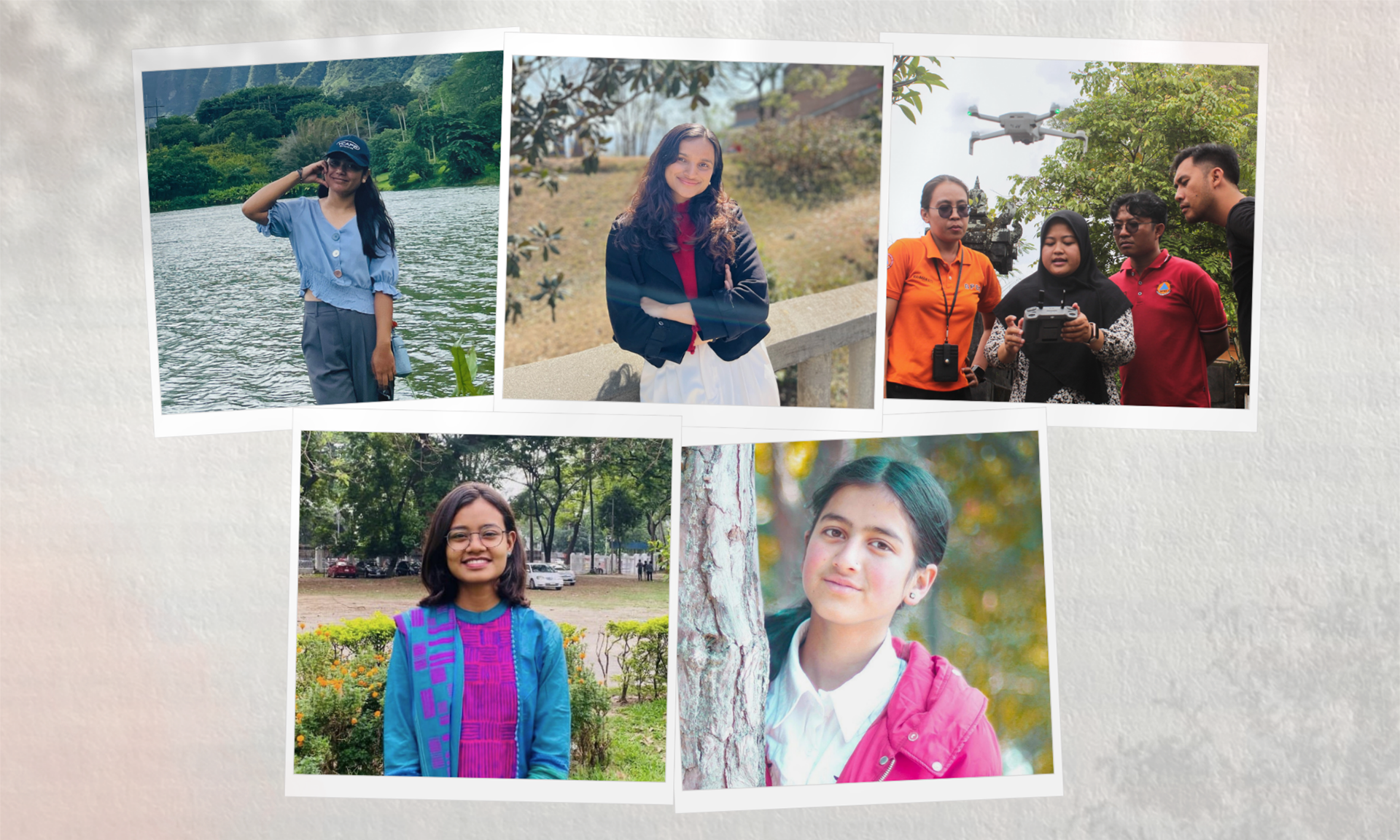
Posted by Julmira de Almeida, Niruta Neupane, Rizky Hadwiyanti, Nafisa Nandini, Prativa Thapa, Tony Liong • March 8, 2026
Julmira de Almeida – Timor-Leste
1) Tell us about your journey with HOT's Open Mapping Hub - Asia-Pacific.
Two years ago, I participated in the Open Mapping Guru Fellowship where I was part of the Mapping Team. During the six-month fellowship, I learned many advanced geospatial tools from experienced mentors and experts across Asia. This program significantly enhanced my technical skills in mapping, spatial analysis, and data management. It also strengthened my confidence and leadership skills.
In addition to the fellowship, I actively participated in online workshops and mapathons, which further deepened my knowledge of open mapping practices and humanitarian mapping.
2) Most valuable insight or meaningful moment throughout your journey.
One of the most meaningful moments was collaborating with OpenStreetMap Timor-Leste to organize and facilitate an in-person mapathon with youth and university students. Together, we contributed data through the Tasking Manager to support disaster response efforts. Seeing young people actively mapping their own communities and understanding how their contributions could support real humanitarian action was incredibly powerful for me.
Another memorable experience was using tools such as Mapillary and Every Door to connect digital mapping with real-world community engagement. Through these activities, I realized that geospatial data can strengthen disaster preparedness and give communities the tools to better understand and respond to risks.
3) How has your work in open mapping made an impact in your community?
As a woman who is passionate about open mapping, I actively contribute through G-SIG, the organization where I currently serve, in partnership with World Vision Timor-Leste, which focuses on disaster risk reduction and emergency response. We utilize open-source software to respond to environmental challenges and disasters. We map disaster-prone areas and population groups, locate safe evacuation points, and assess emergency shelters.
In addition, we use Ushahidi to train youth, women, community members, and civil protection to monitor and report if disaster happens. This has strengthened communities’ knowledge on how to read and understand maps, identify risks, and raise their voices by reporting these risks to decision-makers through open mapping tools.
4) What does being a woman leader in the open mapping space mean to you?
For me, it means showing that women especially in Timor-Leste can lead in geospatial technology, disaster risk reduction, and digital innovation. It means not only building maps, but building confidence among young women who may not see themselves represented in technical fields.
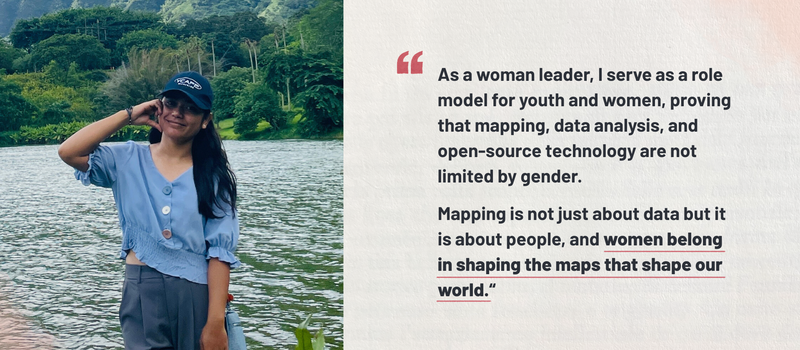
As a woman leader, I serve as a role model for youth and women, proving that mapping, data analysis, and open-source technology are not limited by gender. Leadership in this space means mentoring others, facilitating inclusive learning environments, and ensuring that women’s voices are included in data collection, decision-making, and community resilience planning.
5) Message for other women in the open mapping space (and beyond).
Be confident, keep learning, and lift others as you grow. Mapping is not just about data but it is about people, and women belong in shaping the maps that shape our world.
Learn more about Julmira’s work with G-SIG Timor-Leste in her blog.
Niruta Neupane – Nepal
1) Tell us about your journey with HOT's Open Mapping Hub - Asia-Pacific.
My journey started while I was still a student of Geomatics Engineering, curious about how maps could go beyond classrooms and actually help people. I joined OpenStreetMap activities early in my university life and gradually grew into the role of an Open Mapping Guru.
Over the years, I have led and supported mapathons, field mapping activities using Field-TM, disaster response mapping, and OpenStreetMap trainings at university and community level. I have also been fortunate to receive fellowships and grants that supported women leadership, climate resilience, and humanitarian mapping in the Asia-Pacific region.
What began as volunteering slowly shaped my professional direction and gave me the confidence to step into leadership roles while still learning.
2) Most valuable insight or meaningful moment throughout your journey.
One of the most meaningful moments for me was mentoring new mappers, especially women, who initially felt intimidated by maps, tools, and technical terms. Watching them go from hesitation to confidently contributing data and asking questions was powerful.
The biggest insight I gained is that open mapping is not only technical work. It is about trust, patience, and creating space for people to grow. I realized that leadership does not mean knowing everything. It means learning openly and helping others feel that they belong in the process. That realization changed how I see both mapping and myself.
3) How has your work in open mapping made an impact in your community?
Through open mapping, I have helped bring students and young people into real-world mapping practices that matter beyond grades and assignments. The data created through our mapathons and field mapping has supported disaster preparedness, navigation, accessibility, and urban planning use cases.
I have also worked actively to encourage women’s participation by leading trainings, organizing inclusive events, and showing by example that women can handle both technical and leadership roles. In a field where women are still underrepresented, simply being visible and consistent has helped others believe that they can do it too.
4) What does being a woman leader in the open mapping space mean to you?
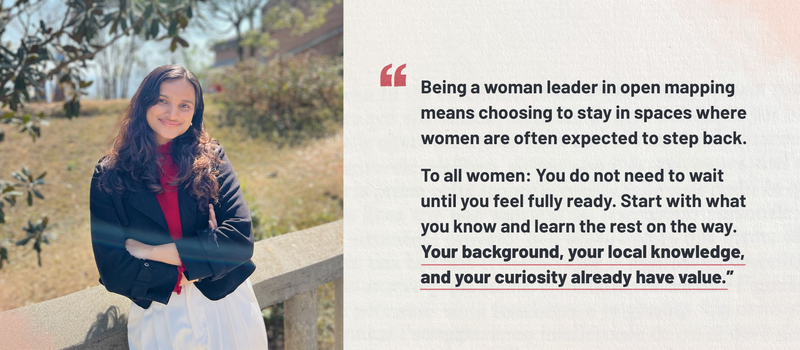
Being a woman leader in open mapping means choosing to stay in spaces where women are often expected to step back. It means leading while learning, making mistakes publicly, and still moving forward.
For me, leadership is about responsibility. Responsibility to mentor, speak up, and make the path less confusing for the next woman who wants to enter geospatial and open mapping fields. It is not about being perfect. It is about being present and persistent.
5) Message for other women in the open mapping space (and beyond).
You do not need to wait until you feel fully ready. Start with what you know and learn the rest on the way. Your background, your local knowledge, and your curiosity already have value.
Do not let the lack of confidence stop you. Confidence grows after action. If you stay consistent and curious, the skills will follow.
Rizky Hadwiyanti – Indonesia
1) Tell us about your journey with HOT's Open Mapping Hub - Asia-Pacific.
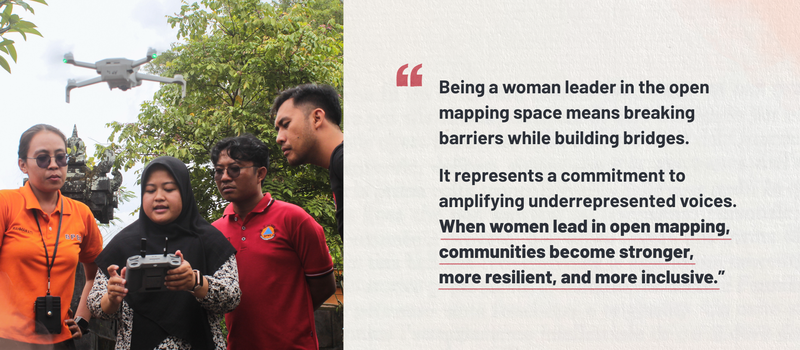
My journey with the Open Mapping Hub - Asia-Pacific has been defined by a commitment to bridging technical innovation with community empowerment. Since 2023, I have served as an Open Mapping Guru, leading participatory mapping initiatives. Through projects such as the End-to-End Mapping Solution (E2E) Bali, I introduced innovative tools including Drone Tasking Manager, ChatMap, Field Tasking Manager, and uMap that made mapping more accessible and collaborative for diverse stakeholders.
Beyond training, I have focused on data quality, disaster preparedness, and inclusive land management, integrating social, economic, and cultural dimensions into survey designs. My role has extended into facilitation and communication: synthesizing technical meetings, field surveys, and organizational activities into clear reports while ensuring bilingual correspondence [and] preserved nuance in complex debates.
This work has strengthened local community mappers in Indonesia [and] contributed to amplifying Southeast Asia’s voice in the global OSM community.
2) Most valuable insight or meaningful moment throughout your journey.
During the E2E Bali project, I acted as a bridge of knowledge, [facilitating training on] new HOT tools in local language [to make it] easier for community to understand. At the start, many participants were hesitant, unsure if they could master tools like Field Tasking Manager or Drone Tasking Manager. Yet by the end, they were not only producing maps but proudly presenting their outputs.
Watching that transformation unfold reminded me that the true impact of open mapping lies not in the data itself, but in the empowerment of communities to see themselves as capable leaders. This experience was deeply meaningful because it reaffirmed my belief that mapping is ultimately about people: giving them the tools, confidence, and voice to shape their own futures.
3) How has your work in open mapping made an impact in your community?
Through open mapping, I have empowered communities to lead disaster preparedness and land management using accessible tools and participatory approaches. By fostering gender equality, I created spaces where women and girls confidently shaped mapping activities, ensuring their voices are central to sustainable, inclusive solutions.
4) What does being a woman leader in the open mapping space mean to you?
To me, being a woman leader in the open mapping space means breaking barriers while building bridges. It is about showing that women can lead with both technical expertise and empathy.
Most importantly, it represents a commitment to amplifying underrepresented voices. When women lead in open mapping, communities become stronger, more resilient, and more inclusive.
5) Message for other women in the open mapping space (and beyond).
Step forward with confidence. Your voice, your perspective, and your leadership matter. Open mapping is not just about data, it’s about shaping futures, and women and girls deserve to be at the center of that transformation. Don’t wait for permission. Claim your space and show that inclusivity and innovation go hand in hand.
Nafisa Nandini – Bangladesh
1) Tell us about your journey with HOT's Open Mapping Hub - Asia-Pacific.
My journey started after I had been selected as an Open Mapping Guru in the 2024 cohort. Working as an enumerator for the "Dhaka Thrive Project" made me realize how much I enjoy field mapping and community activities, [which] led to me applying and getting selected for the "Climate Resilience Fellowship."
2) Most valuable insight or meaningful moment throughout your journey.
During the State of the Map Asia 2024 in Cox's Bazar, a special dinner was arranged for the Gurus, [where] I met Nama, Mikko, Miss Honey, Harry, and other Gurus from Bangladesh, Nepal, and India. All the people were so talented and versatile, yet so kind and down-to-earth. I was the youngest member in the group, and I never felt a bit inferior. The most important lesson I learned was the value of recognizing and honoring even the smallest ideas and opinions shared by others. Meaningful conversations are not built only on strong arguments or dominant voices, but on the willingness to listen attentively and give thoughtful consideration to every perspective.
Another experience [was when] I met Nama, Mikko, and Andrea in the [Climate Resilience Fellowship’s Culmination Week]. I was amazed by the liveliness they brought into the room. Their ability to genuinely connect with everyone reminded me that meaningful change is [also] built on empathy and inspiration. Also during the online sessions of the fellowship, Bernard, Miss Honey, and Harry provided us immense support and essential knowledge for making our projects successful. We were genuinely impacted by their consistent encouragement and constructive feedback.
3) How has your work in open mapping made an impact in your community?
At the University of Dhaka, the struggle to find an accessible female washroom was a daily reality. After 5 pm, most departmental restrooms were locked. Many girls had to walk across campus just to find one open. There were too few female washrooms and very limited access to sanitary napkins, proper lighting, soap, or disposal bins. What felt like a personal inconvenience was actually a systemic gap. In the YouthMappers University of Dhaka Chapter, [using] KoboToolbox and Every Door, we began mapping [washrooms and other facilities] students rely on. We also created detailed maps of the facilities, focusing on gender and disability-based washrooms to inform authorities about the gap.
Another project is "Empowering Communities for Climate Resilience: A Participatory Approach to Waste Management and Water Clogging in Ershad Nagar, Tongi". Together we formed "Waste Clubs", turned waste segregation into engaging community activities, and introduced a Points-for-Trash system that rewarded members for collecting plastic and keeping drains clear. Over 50 households took part. Women stepped forward as leaders. Even one of our members was a person with a speech disability, but she participated actively in all the activities. Based on the feedback received, our community-centered model is not only effective but also scalable and replicable.
4) What does being a woman leader in the open mapping space mean to you?
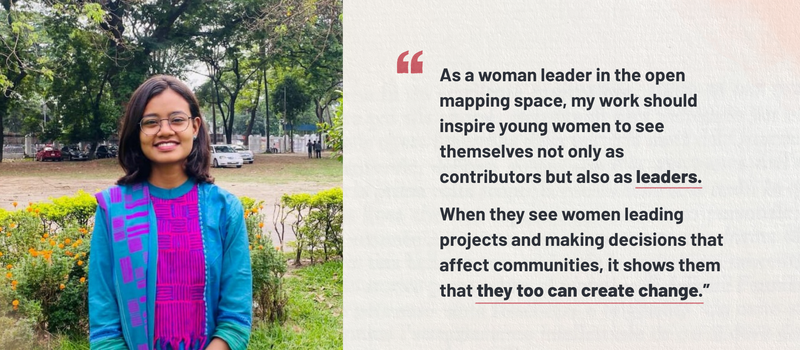
[As] a woman leader in the open mapping space, every initiative I lead must demonstrate that mapping is not just technical work; it is a tool for equity, accessibility, and social change. My work should inspire young women to see themselves not only as contributors but also as leaders. When they see women leading projects and making decisions that affect communities, it shows them that they too can create change.
5) Message for other women in the open mapping space (and beyond).
Step forward, trust your voice, and claim your space. Open mapping and any field need your perspective, creativity, and leadership.
Remember, every map you create, every survey you lead, and every data you share, in fact, every work you do for the community, is more than information; it’s empowerment. Your ideas matter, and they have the power to shape communities in meaningful ways.
Prativa Thapa – Nepal
1) Tell us about your journey with HOT's Open Mapping Hub - Asia-Pacific.
My journey began in 2023 when I joined Kathmandu University as a Geomatics Engineering student. During my early academic days, I participated in a basic OpenStreetMap training conducted by an Open Mapping Guru. That training introduced me to the power of open mapping and its role in community development, disaster response, and humanitarian support. I immediately found it to be a meaningful and impactful volunteering opportunity.
Over time, I stepped into leadership roles by organizing and facilitating workshops, training new volunteers, and leading community mapping events. One of the most significant milestones was serving as the Founding President of KU YouthMappers. Through this role, I worked to build a strong student community and encourage more students—especially women—to engage in the geospatial and open mapping field. Leading the chapter helped me strengthen my leadership and community engagement skills while contributing to the broader Open Mapping Hub - Asia-Pacific network.
2) Most valuable insight or meaningful moment throughout your journey.
One of the most meaningful experiences was leading Nepal’s first Inclusive Mapping Week at Kathmandu University in 2025. As the sole Mapping Lead, I organized and coordinated the entire event, bringing together national and international mentors.
What made this experience truly valuable was the strong participation and empowerment of female mappers. In a field where women are often underrepresented, I intentionally designed the event to create a supportive and encouraging space for female students. Seeing women make up more than half of the participants was a proud and emotional moment for me. Many who initially hesitated to join later confidently contributed to mapathons and expressed interest in leadership roles.
It showed me that representation and inclusive leadership truly matter. When women are given opportunities and supportive platforms, they can lead transformative change.
3) How has your work in open mapping made an impact in your community?
During Mapping Week 2025, we mobilized 57% female mappers through weekly humanitarian mapathons. Our team actively supported mapping tasks for Nepal and earthquake-affected areas in Myanmar. Being part of a global response through open mapping showed that even students can contribute meaningfully to international disaster recovery efforts.
Beyond Mapping Week, I have served as a trainer in various institutions across Nepal, helping grow a sustainable mapping community. Additionally, as the Country Lead for Women [in Open] Mapping - Asia [Navigators] representing Nepal, I work to advocate for gender inclusion in mapping, mentor female mappers, and create platforms where women can actively lead and participate. This role has allowed me to extend impact toward long-term structural change in Nepal’s geospatial community.
4) What does being a woman leader in the open mapping space mean to you?
Being a woman leader in the open mapping space means creating opportunities, visibility, and supportive environments where more women and underrepresented groups can confidently participate and lead, ensuring that diverse voices shape geospatial data.
It means advocating for ethical and community-centered mapping, encouraging collaboration over competition, and demonstrating that women belong in technology and spatial decision-making spaces. A woman leader helps pave the way for future generations of mappers.
5) Message for other women in the open mapping space (and beyond).
Your voice, your perspective, and your presence matter more than you think. The maps we create shape how the world is understood and who is seen. When you contribute, you are adding lived experience, local knowledge, and new ways of thinking.
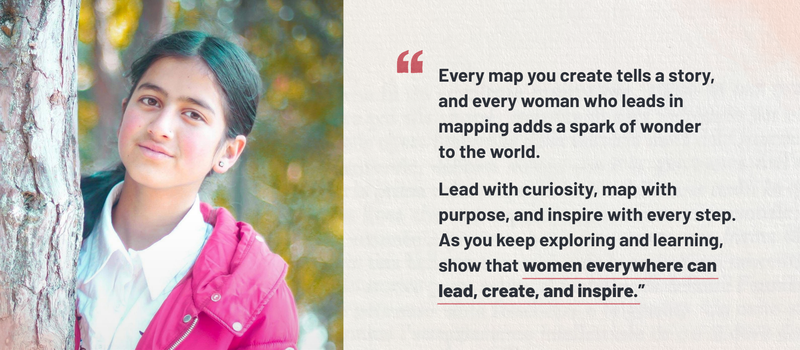
Every map you create tells a story, and every woman who leads in mapping adds a spark of wonder to the world. Lead with curiosity, map with purpose, and inspire with every step. As you keep exploring and learning, show that women everywhere can lead, create, and inspire.
Learn more about Prativa’s experience leading Nepal’s Inclusive Mapping Week 2025 in her blog.
Thank you to the Open Mapping Gurus for the insights, voices, and experiences that made this article possible: Julmira de Almeida, Niruta Neupane, Rizky Hadwiyanti, Nafisa Nandini, Prativa Thapa. May you continue inspiring others and making an impact through your work.
This article features the Gurus’ words and direct responses, with opening paragraph and editorial contributions from Tony Liong.
Photos courtesy of the Open Mapping Gurus featured.
Share