




HOT Open Source Contributor Journeys: Celebrating 2025 and Igniting Inspiration for 2026
Posted by Petya Kangalova • Dec. 22, 2025
Hi everyone, Petya here, HOT’s Tech Partnership and Engagement Lead.
Back in March 2025 we published a blog titled” Open Source Contributor Journeys into HOT - could you be the next one? featuring two contributors - Faiz and Emir. As we reach the end of 2025, I am so excited and grateful to say that we have indeed had more contributors - the amazing people bringing their passion and skills contributing to HOT Tech tools. We have managed to send HOT swag to them as a small gesture of appreciation.
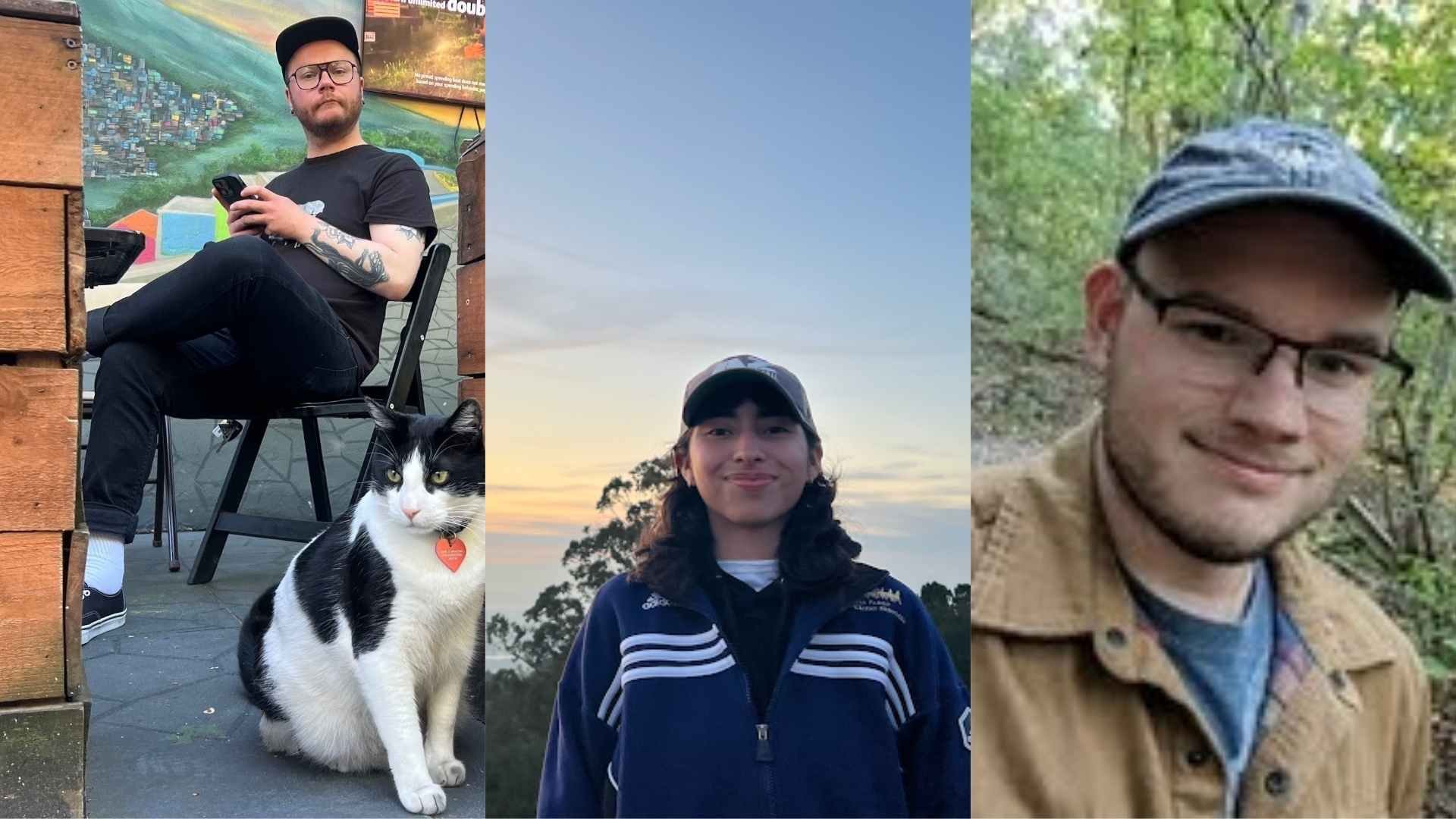
So let’s hear the stories from three of them - Tyler, Luke and Allison! Hope you get inspired by their stories and YOU can start your own open source contributor journey! You can do that by looking for good-first issues in our GitHub repositories or checking the current volunteer projects listed on Github. New to GitHub? Check out the comprehensive GitHub Guide to HOTOSM.
Sign up to our HOT tech newsletter and register for our monthly Tech and Innovation working groups.
As always, feel free to reach out to me directly if you have any questions or if you’d like to share your open source contributor journey!! petya.kangalova@hotosm.org
Tyler’s journey into HOTOSM

- What is your name, where you feel like home, current role.
My name is Tyler and I'm based in Portland, Oregon. I'm a frontend developer with 6+ years of experience, currently contributing to HOT as a volunteer while searching for my next role. - How did you start your journey into tech and open source?
I got into tech through a bootcamp in 2018, but my path wasn't typical. I didn't grow up dreaming about coding. I grew up wanting to help people. I spent time in South Africa working with street kids and after school programs, and I was in Haiti after the earthquake doing relief work. Those experiences showed me the gap between need and resources, and I realized tech could be a bridge. I wanted skills that could scale impact beyond what I could do with just my hands and time. Open source made sense to me because it's built on the same principle as the humanitarian work I'd done, people contributing what they can to solve problems bigger than themselves. - How did you find out about HOT? What was your journey/ what brought you into HOT?
HOT was exactly what I'd been looking for. After years working in tech, I wanted to get back to my roots. Combining technical skills with humanitarian impact. I started researching organizations at that intersection and HOT kept coming up. When I saw that the tools being built were used by MSF, Red Cross, and other organizations doing actual disaster response, it clicked. This wasn't a theoretical impact, this was infrastructure that mattered. I reached out, started contributing, and immediately felt like I'd found my people. - What was your contribution to HOT?
I've been contributing to the XLSForm builder and the hotosm/ui project.
With XLSForm builder, I've been focused on establishing the foundation by integrating the HOT UI design system, setting up development tooling like ESLint and Prettier, and creating a responsive layout that works across devices. A lot of it has been infrastructure work. Making sure components are consistent with HOT's visual identity, setting up SCSS with design system variables, and ensuring the codebase is maintainable for future contributors.
For HOT/ui, I've been participating in PR reviews and helping build out reusable components using Web Awesome and Lit that can be shared across HOT's tools. The framework-agnostic approach means these components can work across all of HOT's different projects regardless of what tech stack they're using.
I’ve been learning a ton along the way too! Web Components were new territory for me, and working on a design system that needs to serve multiple projects has pushed me to think more systematically about reusability and consistency. - What is the one advice you would give to a newcomer wanting to contribute to HOTOSM?
Just start! Seriously. Don't wait until you feel "ready" or think you need to be an expert. HOT's community is welcoming and the maintainers are helpful. Pick an issue labeled "good first issue," ask questions, and be willing to learn in public. The work matters too much to let imposter syndrome keep you on the sidelines.
Allison’s journey into HOTOSM

- What is your name, where you feel like home, current role.
My name is Allison and I am based in Northern California. I am currently contributing to HOTOSM as a Backend Software Engineer volunteer. - How did you start your journey into tech and open source?
My background is actually in Biology, where I focused on understanding environmental systems. However, I often felt that studying these systems in isolation was missing an integral relationship: the community aspect.
I realized that scientific disciplines often fail to incorporate the communities that sit at the center of the issues that they want to address, and I struggled to find a way to practice science in isolation, as I wanted my work to be community-centered.
To bridge this gap, I spent the last year building the fundamental technical skills necessary to do this work.
I saw that open source could be used as a tool to democratize this scientific knowledge, but only if it kept this consideration of who it serves in mind. My journey into tech has been about learning how to build community-centered solutions that balances creating tools that are open and accessible, while also aiming to protect the data sovereignty and rights of the communities represented within that data. - How did you find out about HOT? What was your journey/ what brought you into HOT?
As I was looking for ways to get involved with community-centered technical organizations, I came across HOT. I was specifically seeking an environment where technology was not just applied to communities, but rather used by communities to define their own geographies.
I was drawn to the mobilization aspect to the different humanitarian projects HOT worked on, from mapping health zones after an Ebola outbreak to indigenous communities utilizing mapping to protect their forest against potential threats. I felt that HOT provided the environment that I wanted to contribute to as it aligned with my goals towards building infrastructure that supports local resilience.
I essentially then joined HOT’s Slack channel, asked how I could get involved and picked up a Github issue. - What was your contribution to HOT - can you tell us a bit more.
So far I have worked on Field-TM and Drone-TM.
For Field-TM, I worked on improving version control for XLSForm survey forms.
The goal was to convert existing XLSForm files (Excel files), which are hard to track, to text-based YAML files. During implementation, I identified that the external conversion library required writing to a physical disk, which conflicted with read-only production environments. My findings allowed Sam Woodcock to create an update in the library to support in-memory processing, allowing the migration to proceed.
For Drone-TM, I focused on implementing an automated cleanup process to ensure that NodeODM server deletes processing jobs that it has completed, so the system doesn’t get congested with old data. To verify these changes, I am also fixing the local testing setup so that future developers can reliably run a testing environment on their own machines. - What is the one advice you would give to a newcomer wanting to contribute to HOTOSM?
My advice is to remember that there are a multitude of ways to contribute. Whether it’s writing code, contributing to mapping initiatives or improving documentation, it’s all helpful.
Also, don’t be afraid to ask questions! It’s easy to feel like you need to know everything before jumping into tackling/contributing to an issue, but I learned that the HOT community is really supportive. I’ve been lucky to learn (and am still learning!) the fundamentals of open-source development, especially from Sam Woodcock, as he’s been a big help in answering all of my questions and providing feedback to help me tackle complicated technical challenges.
Luke’s journey into HOTOSM
- What is your name, where you feel like home, current role.
My name is Luke Everhart. I live and work near Cleveland. Ohio. I have worked as a Software Verification Engineer in the tech sector for the last 3 years. I am also actively pursuing a masters degree in GIS. I contribute to HOTOSM as a tech volunteer between my day job and my coursework. - How did you start your journey into tech and open source?
I started out with tech in my undergrad coursework when I was studying Computer Engineering. My first job after graduation had me working intensively in Linux environments where I gained a respect for open source and strived to develop tech stacks that were as open source as I could get away with. In a tech culture ripe with proprietary software licenses and expensive cloud services, the mission of free and open software drew me in because of the idea that I could simply create something useful for others and contribute in my own small way to the greater mission of open source. - How did you find out about HOT? What was your journey/ what brought you into HOT?
As a long time fan of the OpenStreetMap project, I was looking for a way to contribute to the project in a way that best utilized what abilities. I became aware of HOT when I began interacting with the wider OpenStreetMap community more regularly at the beginning of this year. When I dug deeper into the project and saw the critical data infrastructure this community has been building across the world, HOT seemed like the perfect place to contribute. So I reached out to the community in the Slack and offered up my time as a tech volunteer. Within a week I had a project to work on and was contributing code. - What was your contribution to HOT?
I have been working on a Python module called geojson_aoi_parser. The goal of the module is to take a wide range of different types of .geojson file inputs and transform them into one standardized output. This is needed because different frontend applications in HOT’s stack (FieldTM, and DroneTM, for example) often perform an operation just like this, but each application has its own specific input data then needs to be transformed on an app by app basis. With geojson_aoi_parser, each application would only need to import the module rather than all having their own unique implementations.
Working on this project has introduced me to so many new concepts. From docker containers to geospatial algorithms, every time I sit down to work on it I’m learning something new. - What is the one advice you would give to a newcomer wanting to contribute to HOTOSM?
Whether you want to be a tech contributor or a mapper and don’t know where to start, the best thing you can do is reach out to folks on the community Slack and say that you are willing to contribute. That is so much work to be done and you will get someone to point you in a direction where you can make the biggest personal impact with the abilities you bring with you.
My advice for tech volunteers in particular is to take on a project that has a clear deliverable. If there is something that you can finish and call your own, it is much easier to stay motivated and keep working. Also, do not be afraid to reach out to the wider community and ask questions if you are stuck. Everyone here is remarkably patient and willing to help through any problems.
Share